
Alexandre de Riquer i Ynglada (1856-1920) Bookplates
On Alexandre de Riquer:
—Biography —Posters —Interiors decoration —Bookplates—Literature —Painting —Other pursuits
|
|


Bookplates List
–A. de Riquer (3) (1900 –
1901 – 1903)
–Rafel Patxot (1901)
Joan Llongueras (1) (1901)
Joan Llongueras (2) (1901)
-Narcís Clavell (1902)
-Rafael Domènech (1902)
-Macario Fau (1902)
–Vicente García de Paredes (1902)
-Federico Larrañaga (1902)
–Marquina (1902)
-Teresa i María (1902)
–Francesc Matheu (1902)
–Leonor Miquel (1902)
–Eugeni Ors (1902)
-J. Pin y Soler (1902)
-Josep M. Roca (1902)
-Santiago Rusiñol (1902)
-Hermann Schultze (1902)
–F. Soler (1902)
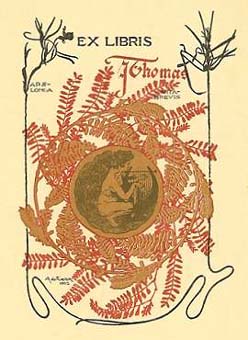
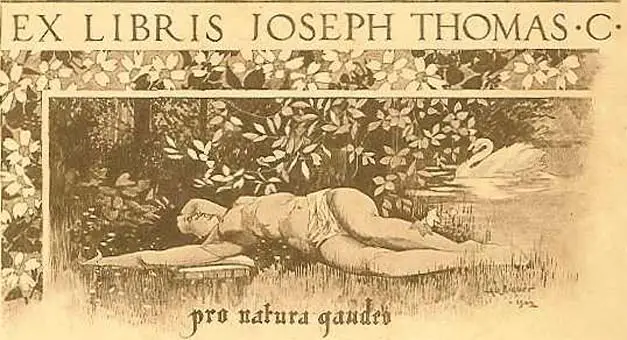
–Joseph Thomas (1902)
–Emili Cabot (1903)
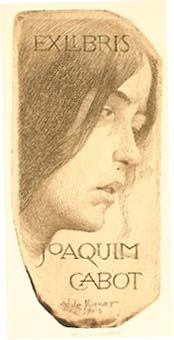
–Joaquim Cabot (1903)
–Raymond Casellas (1903)
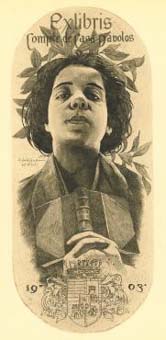
–Comte de Casa Davolos (1903)
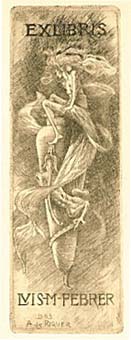
–Luís M. Febrer (1903)
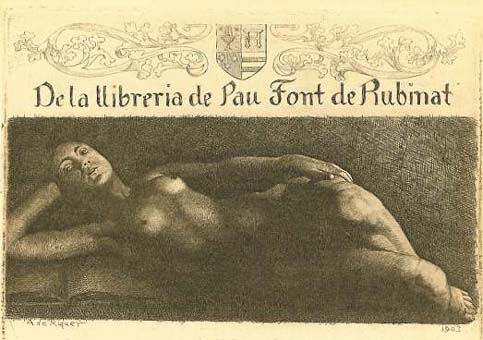
–De la llibreria de Pau Font de Rubinat (1903)
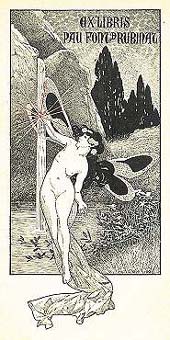
–Pau Font de Rubinat (1903)
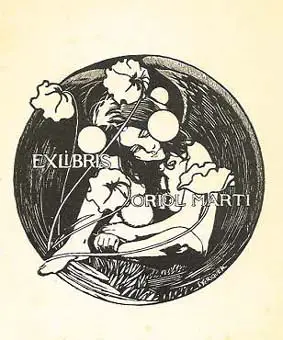
–Oriol Martí (1903)
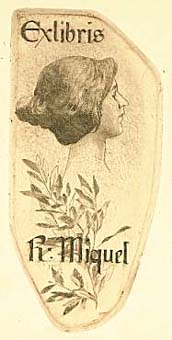
–R. Miquel (1903)
–Dr. Rudolf Newmann (1903)
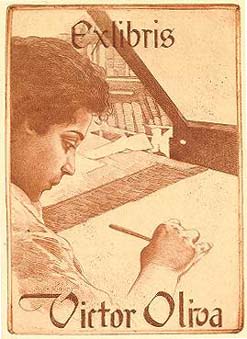
–Víctor Oliva (1903)
–Paquita (Francisca Bonnemaison) (1903)
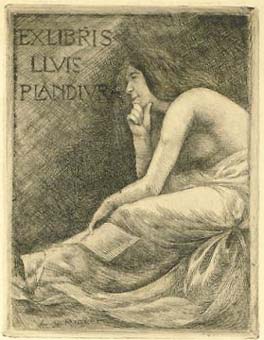
–Lluís Plandiura (1903)
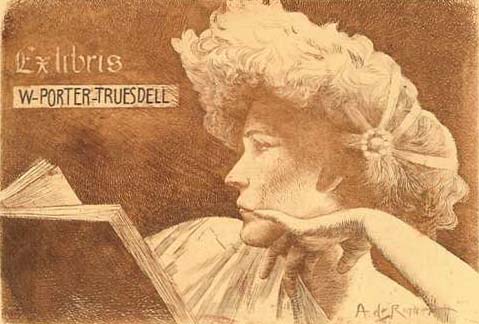
–W. Porter-Truesdell (1903)
–Alfonso XIII (1904)
-Apel·les Mestres (1904)
–Joan Subirachs (1904)
-Jordi Montsalvatge (ex-musicis 1905)
-Joseph Montsalvatge (1905)
-Hugo Sanner (1906)
-José Espasa e Hijos, Editores (1909)
-Anton Dalmau (2) (1913 – 1914)
-Trinidad Montsalvatge (1913)
-Joseph Montsalvatge (Ex-musicis 1913)
-Josep Fabregat (1913)
-Enrique Granados (Ex-musicis 1913)
-José Mª de Careaga Montsalvatge (1913)
-Andrée Bearn (1916)
-Frederich Miracle (2) (1916 – ?)
–Lluís Bartrina
-Rita Benapres
-Hans Bethge
-Emilio Canals
-Fernando Coll
-Alfons Gallardo
-Garcia Novell
–Carmen J. de F.
–Auguste Laborde
–Lemingen-Westerburg
–F. Lliurat
–J. Llorens
–J. Maragall
-J. Meifrèn
–Manuel de Montoliu
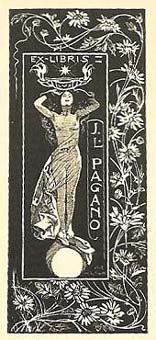
–J. L. Pagano
–M. Parera
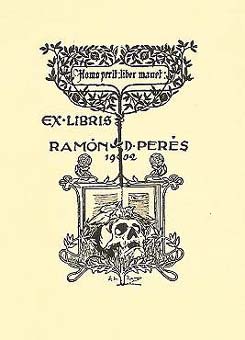
–Ramón Perés
-Angelica Prat
-Jaume Ponsa
-Alexandre J. Riera
–Emilio
de Riquer i Palau
-Ludwig
Saeng
-Leon V.
Solon
-Eudalt Thomas
–F. Thomas
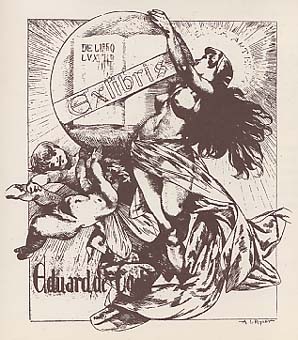
–Eduard
de Toda
–Miquel
Utrillo
–A. VallLlobera
–A. de
Riquer i de Palau
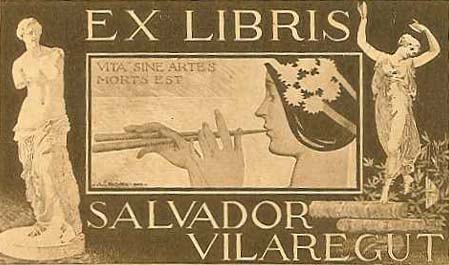
–Salvador Vilaregut
Introduction:
Alexandre de Riquer’s bookplates are miniature artworks; in Catalonia, the association between Alexandre de Riquer and bookplates is unavoidable.
Riquer not only introduced the art of the bookplate into Catalonia, but also was the first both to promote it through publications such as Luz (1898) and Joventut (1900) and to dignify it with engravings.
Riquer was the first Catalan artist to publish a book of bookplates (1903) that catalogued his work up to that point. The prestigious Art Nouveau artist Miquel Utrillo wrote the preface.
The book “Ex-libris d’Alexandre de Riquer” (Bookplates of A. de Riquer):
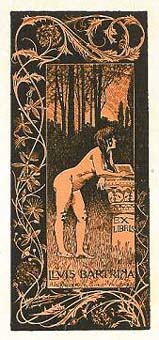
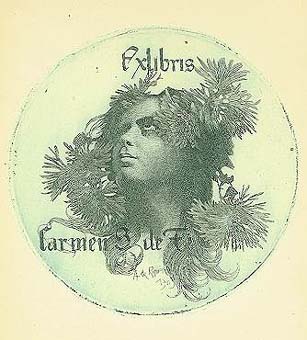
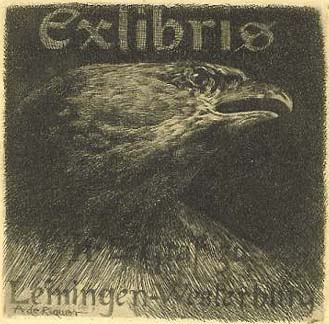
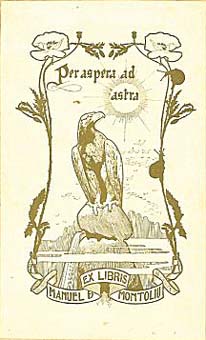
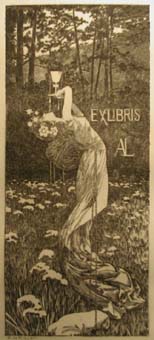
Approximately up until the publication of his book, Riquer’s bookplates had an unequivocally Art Nouveau style. The majority were photoengraved in small form and printed in one or two inks. The central element of the drawing varied – a face, a female figure (often a nude), a woman reading, birds and other animals, vegetable motifs or landscapes – and was usually surrounded by fine, sinuous lines and decorated with floral frames, acanthus leaves, garlands, etc. in the purist Art Nouveau style.
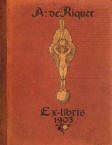
Bookplates of Alexandre de Riquer compiles 63 examples. Left we show the images of the covers of the three existing editions, printed in Barcelona and Leipzig in 1903 and somewhat later in Britain by Williams and Norgate in 1904 or 1905.
Three hundred copies of the book, published in French, were distributed between Barcelona and Leipzig thanks to the patronage of Count Leiningen-Westerburg. Ten copies also appeared on special paper that could feature color images and were signed by the author. In 1904, the last one was sold. This latter edition is unknown even to specialists and rarely figures in discussions of Riquer’s work.
His work and its significance:
Lluís Yebra catalogued 142 bookplates produced by Riquer between 1902 and 1904, a portion of which are reproduced on this page. Another author raises this figure to 200, although this estimate seems slightly high.
After 1904, Riquer inclined towards a more classic style for the central drawing – the nucleus of his designs – maintaining a general Art Nouveau atmosphere, but within traditional lines. He also began to prefer larger formats and employed the technique of etching for more technical designs.
From his first creations, Riquer adapted perfectly to the reigning philosophy of the age of bookplates: he understood their allegorical value, along the lines of ancient heraldry.
He included among his designs the favorite themes of the era (feminine figures, vegetable motifs, flowers, animals, landscapes), always with extraordinary elegance. Women frequently featured in his bookplate production; he addressed women in various states, nude or clothed, sometimes in quite sensual poses. One example of undeniable sexual innuendo are the bookplates Riquer designed for Pau Font de Rubinat, especially the one titled De la llibreria de Pau Font de Rubinat (from the library of Pau Font de Rubinat).
From a formal point of view:
Eliseu Trenc divides Riquer’s work into five groups:
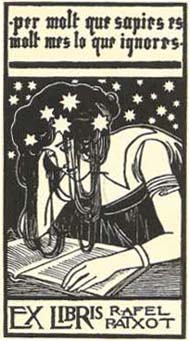
The designs found in the first group, to which the bookplates for Rafel Patxot, Joan Llongueras, and others belong, are very elongated and have an elegant, allegorical female form in the foreground. In the background are trees through which runs a river. With these images, Riquer expresses the poetry of a melancholic nature.
The second group, including bookplates designed for Manuel de Montoliu, Eudald Thomas, and others, are circular or oval with a figure in the center. Outside the circle are floral motifs that surround the name of the owner and the inscription, if any.
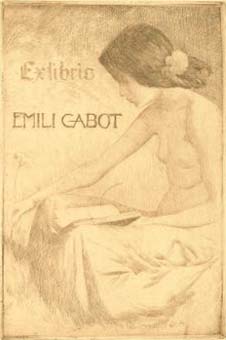
The third group of bookplates, such as those designed for Emili Cabot and R. Casellas, are of a more traditional rectangular form and lack purely decorative elements. More often, they feature female faces or bodies.
The fourth group, encompassing bookplates designed for Paquita, Rita Benapres, Miquel Utrillo, and others, is the most original and modern, with sketches of flowers done in two or three colors.
Finally, Riquer’s bookplates for Carl Neumann and Anton Dalmau, and his bookplate for musical scores designed for F. Lliurat, comprise Trenc’s fifth group. They feature large etched designs generally with a central oval medallion containing an allegorical figure and surrounded by nymphs and foliage. These later bookplates – among Riquer’s last – date from 1907 to 1914.
Founder of a “school” of bookplate art:
Riquer became the founder of a brilliant school of bookplate artists, including such illustrious names as J. Triadó, J. Renart, J. Dieguez, J. Llongueras, F. Galí, and I. Moya, all them counted today among the most recognized Catalan bookplate artists.
Eugeni d’Ors, founder of Noucentisme (the movement faced with and immediately following the Art Nouveau), recognized Riquer’s studio in Barcelona as the “only fount of true art in Barcelona” – and this despite the profound artistic discrepancies between the two men’s philosophies.
The value of Riquer’s work today:
The bookplates designed by Alexandre de Riquer are increasingly appreciated by experts the world over, as evidenced both by the success of ever more frequent exhibitions (such as the ones in Ortona, Italy in 1993 and in Caixa de Terrassa in 2000) and by the burgeoning scholarship surrounding Riquer’s work.
Various websites are also contributing to Riquer’s renown, apart from the pages we have the pleasure to provide for you here, which we hope to expand in the near future.
 |
 |
 |
 |
|
Bookplates of Alexandre de Riquer |
Rafel Patxot |
Joan Llongueras |
|
|
|
 |
 |
 |
|
|
Francesc Matheu |
Leonor Miquel |
Eugeni Ors |
 |
 |
 |
 |
|
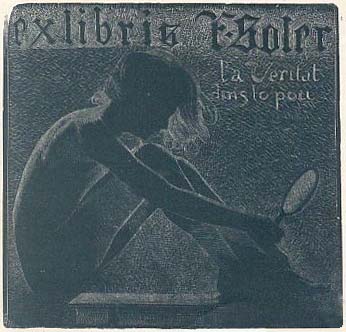
F. Soler |
Emili Cabot |
Joaquim Cabot |
Raymond Casellas |
 |
 |
 |
 |
|
Comte de Casa Davolos |
Luís M. Febrer |
Pau Font de Rubinat |
Oriol Martí |
 |
 |
 |
 |
R. Miquel |
Dr. Rudolf Newmann |
Victor Oliva |
Paquita (Fca. Bonnemaison) |
 |
 |
 |
 |
Lluís Plandiura |
Alfonso XIII |
Joan Subirachs |
Lluís Bartrina |
 |
 |
 |
 |
|
Carmen J. de F. |
Lemingen-Westerburg |
F. Lliurat |
J. Llorens |
 |
 |
 |
 |
J. Maragall
|
Manuel de Montoliu
|
J. L. Pagano
|
M. Parera (a rare version in red) |
 |
 |
 |
 |
Ramón Perés |
F. Thomas |
Eduard de Toda |
Miquel Utrillo |
 |
 |
 |
|
|
Auguste Laborde |
V. García de Paredes |
From the library of Pau Font de Rubinat |
|
 |
 |
||
|
W. Porter-Truesdell |
A. de Riquer i de Palau |
||
 |
 |
||
Joseph Thomas |
Salvador Vilaregut |
||